The “Tech Neck” Epidemic: How to Save Your Spine From Permanent Damage in 30 Seconds
By Dr. Neo (The Natural Health Guru) Posted on February 28, 2026 | Wellness & Posture
Stop. Don’t Move. Look at Your Chin.
I want you to freeze right now. Don’t move a muscle.
Where is your chin? Is it tucked down against your chest? Are your shoulders rolled forward like you’re trying to protect your heart from a breakup? If you are reading this on your smartphone, there is a 99% chance you look like a turtle hiding in its shell.
I say this with love—like your grandmother who tells you you’re looking a little thin—but you are crushing your own spine.
We live in a world where we are addicted to the scroll. We doomscroll on TikTok, we check emails in bed, and we text while walking. But here is the scary truth that Big Tech doesn’t tell you: looking down at your phone isn’t just a bad habit; it is a physiological disaster.
You might feel that dull ache at the base of your skull right now. Maybe it’s a sharp pinch between your shoulder blades. That isn’t just “tiredness.” That is your body screaming for help.
You don’t need expensive surgery, and you certainly don’t need to live on painkillers. The solution to “Tech Neck” is likely already in your house. In fact, all you need is a doorway and 30 seconds of your time.
Let’s fix that neck before it snaps, shall we?
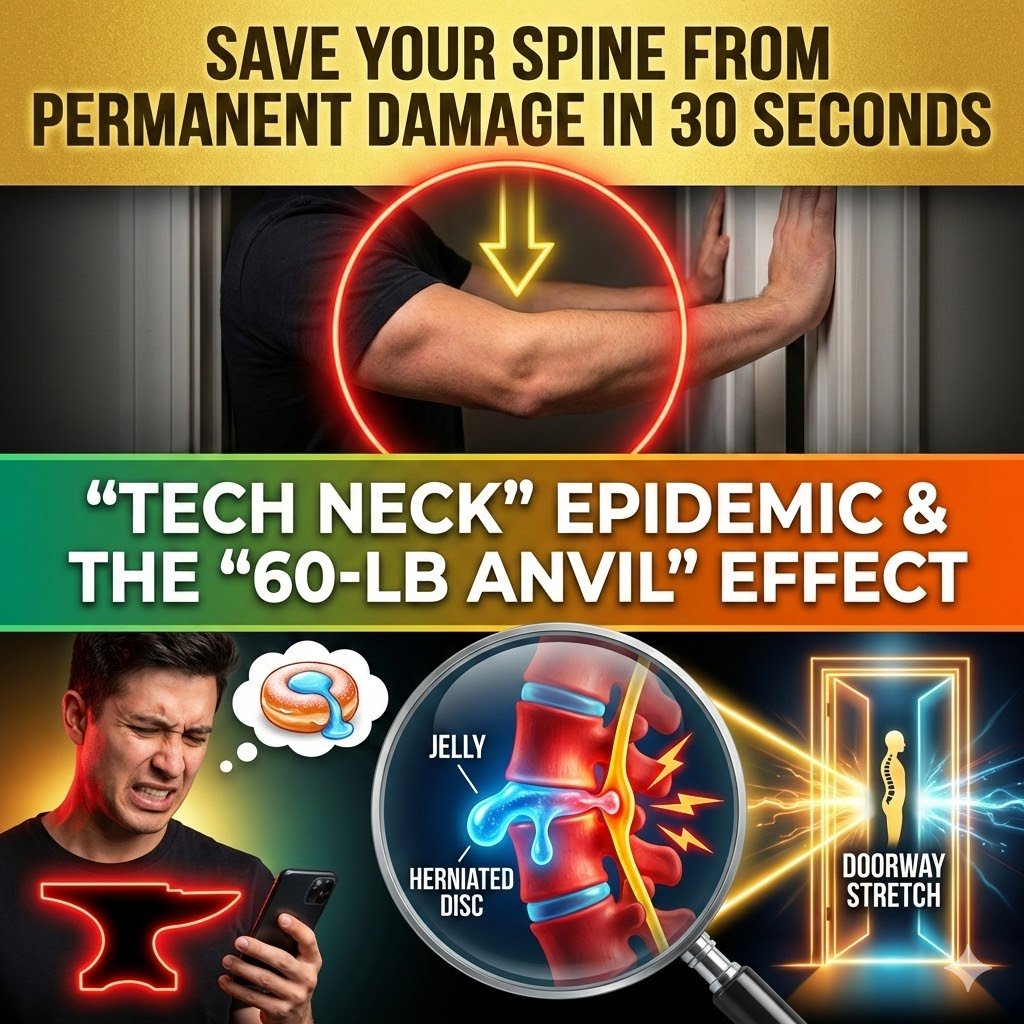
The Science: The “Jelly Donut” & The 60-lb Anvil
You might think, “Oh, it’s just a little stiffness, I’m fine.” No, honey, you are not fine. Let me break down the biomechanics of what is happening inside your body right now, using simple terms.
1. The Anvil Effect (Physics 101)
Your head is heavy. In a neutral position (ears aligned with shoulders), it weighs about 10 to 12 pounds. Your neck muscles and cervical spine are designed to carry that weight perfectly. It’s effortless.
However, physics is a cruel mistress. For every inch you tilt your head forward, the gravitational pull on your cervical spine doubles.
- 0 degrees: 10-12 lbs (Normal)
- 15 degrees: 27 lbs
- 60 degrees (The Texting Zone): 60 lbs
Imagine carrying an 8-year-old child around your neck all day. Or better yet, imagine a 60-lb iron anvil sitting on the back of your neck. That is exactly what your spine feels every time you check a notification. Your neck muscles have to work overtime just to keep your head from falling off, leading to those rock-hard knots in your shoulders.
2. The Jelly Donut Analogy
Your spine is made of vertebrae (bones) and discs (shock absorbers). Think of those discs like a jelly donut. The outside is tough dough (annulus fibrosus), and the inside is soft, blue jelly (nucleus pulposus).
When you have that “60-lb anvil” force pushing down on a curved spine, it acts like a hydraulic press. It squishes the front of the vertebrae together. Eventually, that pressure has to go somewhere. So, the “jelly” shoots out the back.
Warning: This is what we call a herniated disc. That “jelly” hits a nerve root, and suddenly you have shooting pain down your arm or numbness in your fingers. And unlike a donut, you can’t just go to the bakery and buy a fresh disc. Once that jelly is out, it is incredibly hard to put back in.
The Solution: The “Doorway Stretch” Protocol
So, how do we get that anvil off your neck? We have to reverse the curvature.
Most people try to fix this by just “pulling their head back.” That doesn’t work because your chest muscles (pectorals) are tight from slumping forward all day. They are dragging your shoulders down. We need to open the gate first.
Here is the exact protocol I use with my patients.
What You Need:
- A standard door frame (open the door!).
- 30 seconds of your time.
- No fancy equipment. No expensive gadgets.
The Step-by-Step Guide:
- Find Your Spot: Stand in an open doorway.
- Goalpost Arms: Lift your arms up to 90 degrees. Your elbows should be at shoulder height, and your forearms should rest flat against the door frame on either side. You should look like a football goalpost.
- The Step Through: Place one foot forward through the doorway gently (like a lunge).
- The Lean: Lean your body weight forward through the door until you feel a deep, pleasurable stretch across your chest and the front of your shoulders.
- The Chin Tuck (Crucial!): While you are leaning forward, do not look down! Look straight ahead and slightly tuck your chin back (make a double chin). This aligns the cervical spine.
- Hold & Breathe: Hold this position for 30 seconds. Take deep belly breaths. Visualize that “anvil” disappearing.
Why This Works (The Secret Sauce)
This isn’t magic; it’s mechanics. By stretching the pectoralis minor (chest muscles), you remove the tension that is pulling your shoulders forward. Once the shoulders roll back, the head naturally slides back into its neutral, weightless position. The pressure on the “jelly donut” discs is instantly released.
Expert Tips & Safety Warnings
Listen to your “Natural Health Grandma” carefully here, because I don’t want you hurting yourself trying to get healthy.
- The “Ouch” Rule: If you feel a gentle pulling sensation, that is good. That is a stretch. If you feel sharp, pinching pain or an electric shock sensation, STOP IMMEDIATELY. You are pushing too hard or you have an underlying injury that needs a doctor’s eyes.
- Don’t Over-Arch: Keep your core tight. Don’t let your lower back sway like a banana. We are targeting the chest and neck, not the lower back.
- Numbness is a Red Flag: If you feel tingling traveling down your arm into your pinky or thumb while doing this, stop. That suggests a nerve is already pinched.
- Consistency beats Intensity: Doing this stretch once for 5 minutes is useless. Doing it for 30 seconds every time you stand up to use the bathroom changes your life.
Pro Tip: Set a “Posture Alarm” on your phone for every hour. When it rings, get up, find a doorway, and reset your spine.
Final Thoughts
Your spine is the highway of your nervous system. It controls your energy, your mood, and your ability to move freely. You only get one spine, and Amazon doesn’t sell replacements (yet).
Don’t let a $1,000 phone ruin a priceless body.
Try the stretch right now. Do it before you scroll to the next video or read the next email. Your future self—the one who wants to be able to turn their head when they are 60—will thank you.
Did this stretch help you feel lighter?
Comment “SPINE” below to grab my free 30-Second Posture Fix PDF guide! Let’s get that anvil off your neck.